
For ¥100 — one coin, less than a vending machine coffee — you get unlimited rice refills with your ramen at this narrow Dotonbori counter shop, and the locals who know about it treat that mechanic like a minor superpower. I'd walked past the brown-tiled shopfront twice before I actually went in, which tells you something about how aggressively it doesn't announce itself on a wet Dotonbori evening. The red backlit sign reading 大輝家直系 家系ラーメン 大阪家 OSAKAYA is doing all the work. The rest is just a door, a ticket machine, and the smell of tonkotsu broth and hot-fat chashu searing somewhere behind the counter pulling you through it.
📋 At a Glance
| 📍 Address | わんわんビル 1F, Dotonbori 1-Chome, Chuo Ward, Osaka (道頓堀1-東5-18) |
| 🕐 Hours | 11:00–15:00 / 17:00–23:00 | Irregular closing days (不定休) — check before you go |
| 💴 Budget | ¥1,000–¥1,250 per person (ramen + rice add-on) |
| 🚇 Access | Kintetsu Nippombashi Station Exit 6 (~3 min walk) or Osaka Metro Sakaisuji Line Nippombashi (~5 min walk) |
| 💳 Payment | Cash only — ticket vending machine at entrance |
| ⭐ Best For | Solo budget traveler who eats fast, sits close, and wants to leave full |
Why This Tiny Dotonbori Ramen Shop Survives on the ¥100 Rice Strategy Alone
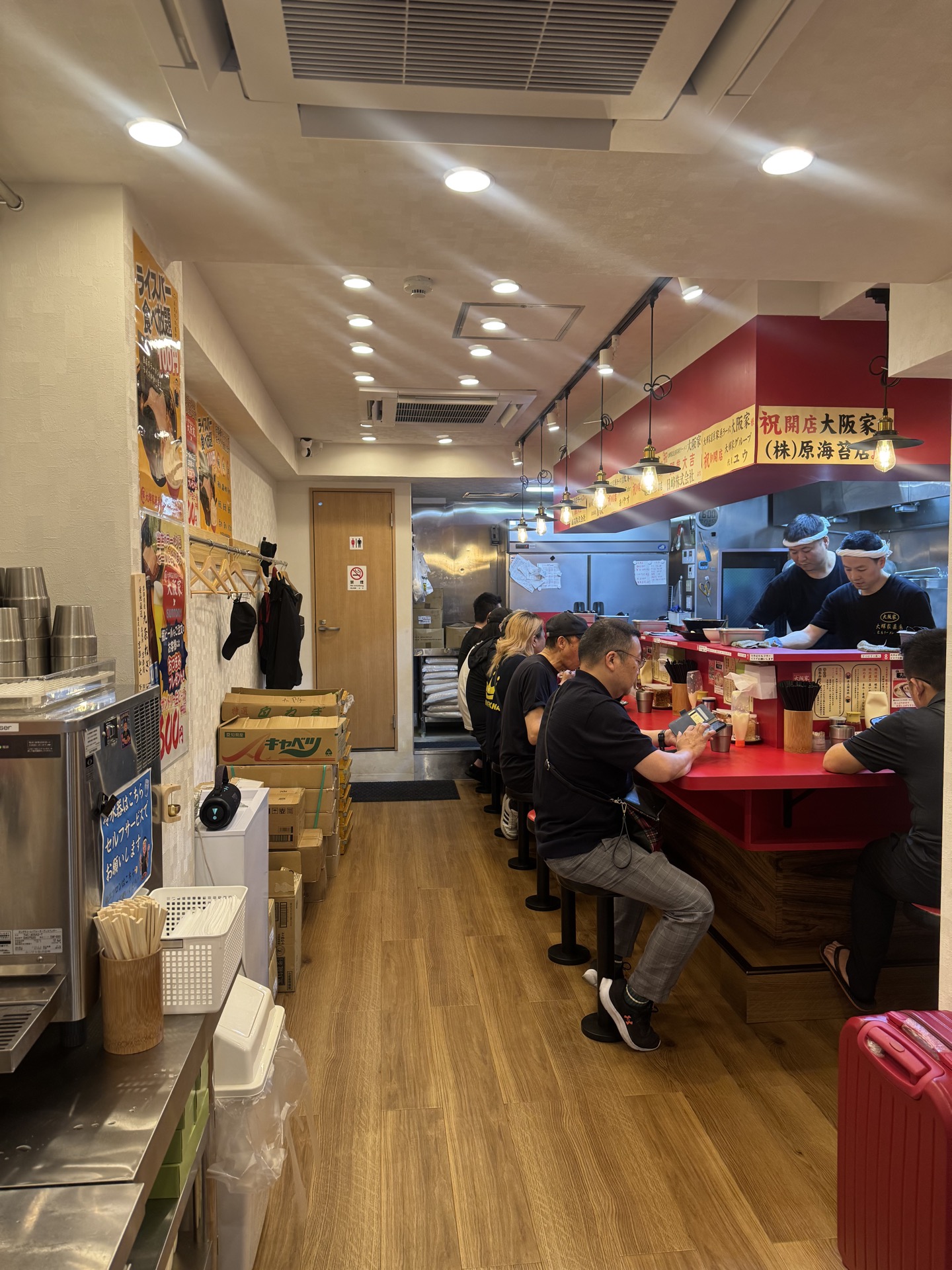
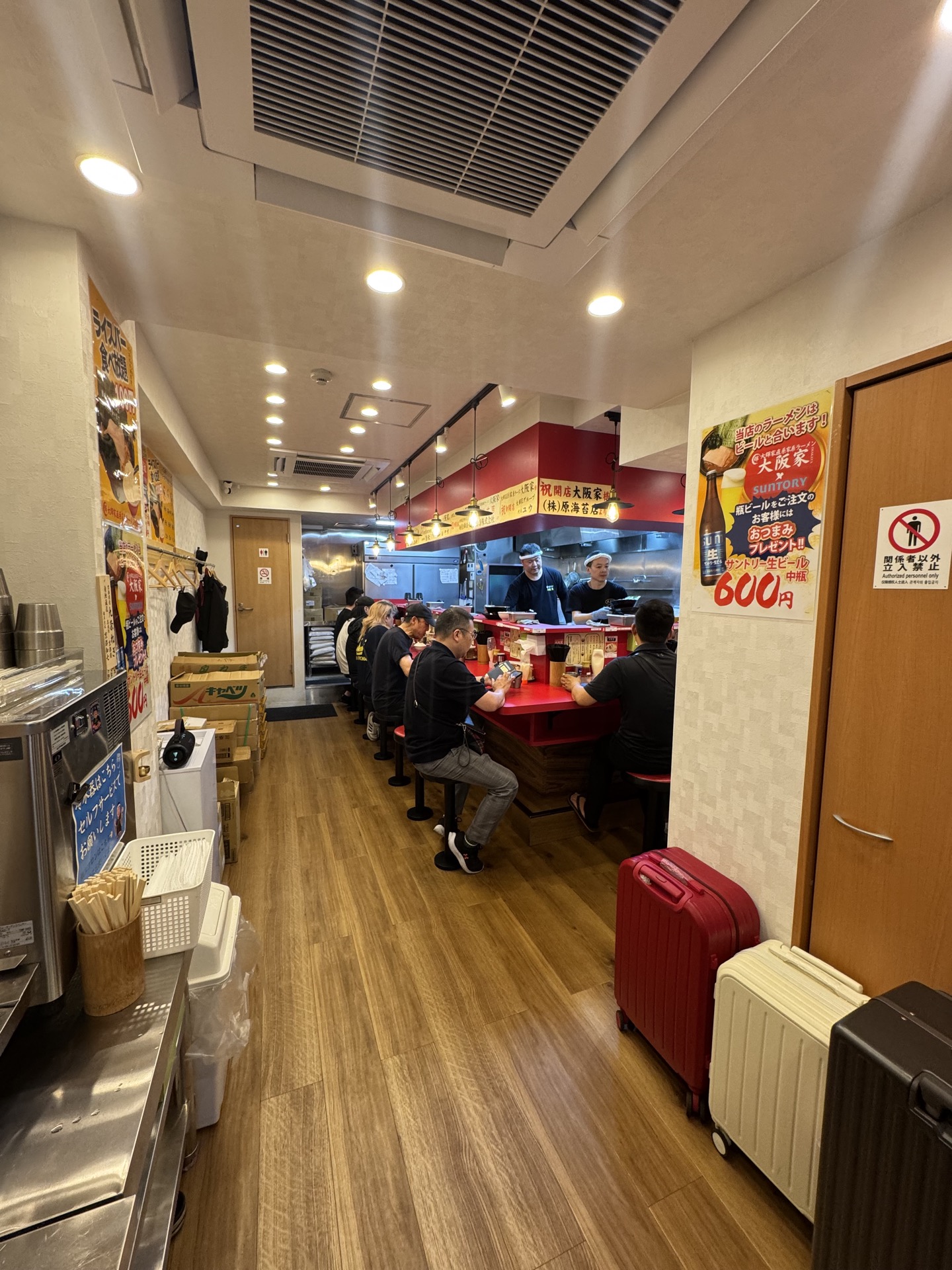
You arrive at 12:15pm on a Tuesday expecting a quiet lunch crowd. Every black backless stool is taken. The galley is maybe three meters wide — a single counter running the full length of the room, ten stools facing an open kitchen where two chefs work under a red ventilation hood that's running loud. Gone. That's the available seating situation the moment you walk in at peak hour. You can see the whole operation from the door: the bowls moving, the ladles, the nori sheets getting placed with the particular speed of someone who has done it ten thousand times.
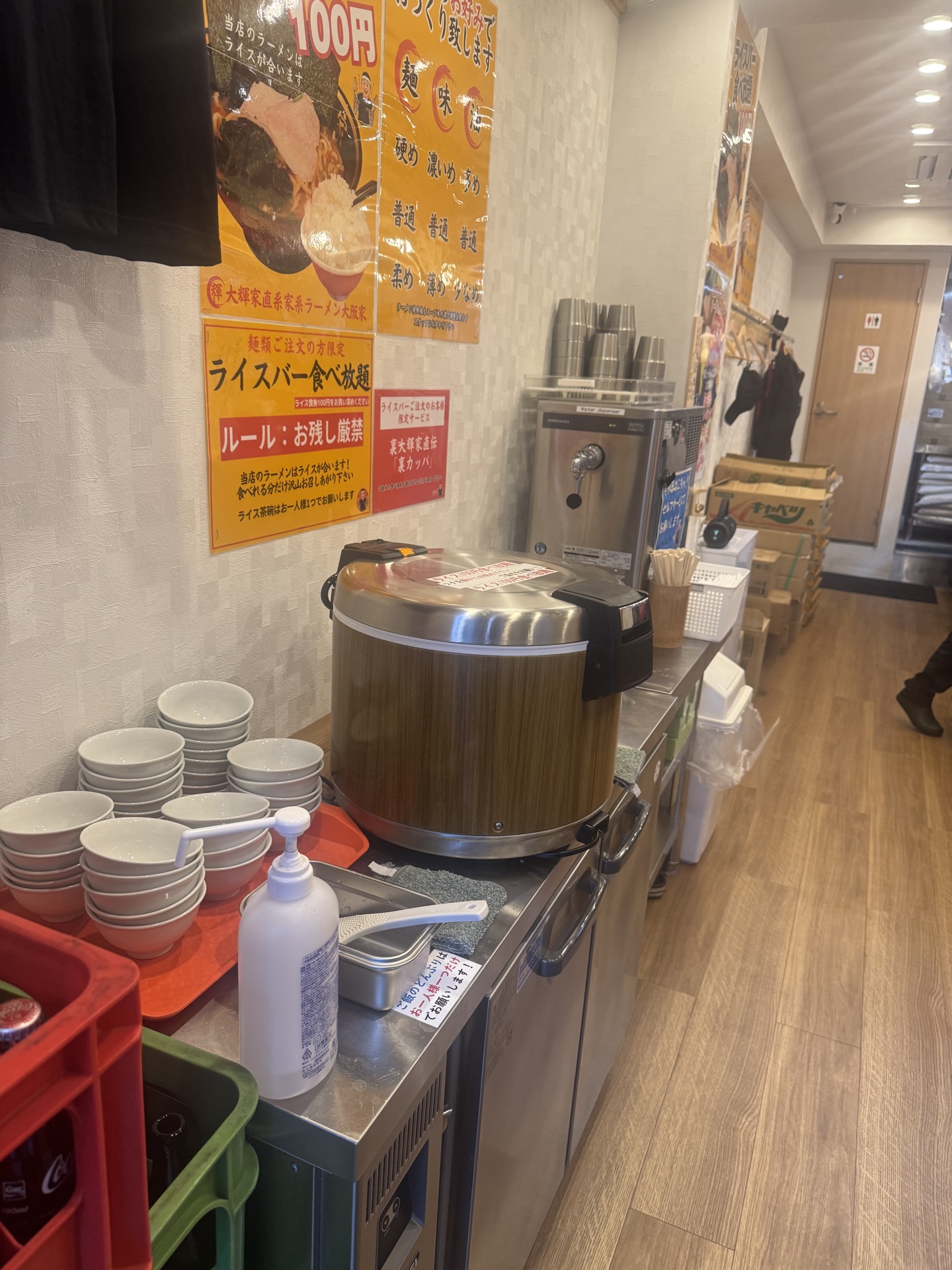
What landed immediately was the rice bar setup on the left wall — a full commercial rice cooker, stacked white bowls, and a poster that says, bluntly, 「お残し厳禁」— No leaving food. Strictly enforced. That sign tells you what kind of place this is: one where the kitchen takes the food seriously enough to not want it wasted, and where the implicit contract between you and the bowl is that you finish what you take. The whole place has a construction-canteen efficiency that you either click with or you don't. I clicked with it.
The caveat worth taking seriously: the irregular closing days (不定休) are a real tax on your afternoon. I walked over once during the 15:00–17:00 break, found the shutters down, and had to loop back for dinner. Learn from that. Check their social media the morning you plan to go — not optional.
The Spice Reality Check — and the Fat Reality Check Nobody Mentions
OSAKAYA is iekei-style — Yokohama family-recipe tonkotsu-soy broth, thick straight noodles, chashu, spinach, nori. When the bowl landed in front of me, the first thing I noticed was the fat sitting on top of the broth. Not a shimmer. A layer. The kind that coats your lips on the first sip and doesn't let go. The nori sheets were half-submerged and already yielding at the edges — not soggy, just giving way — which is exactly right for this style.
Here's what I want to be direct about: if you're not someone who does well with heavy, fatty broths, this bowl will work against you by the halfway point. The salt level is assertive in a way that reads as intentional — it's calibrated to make you reach for rice, which is either clever menu engineering or a lot, depending on your palate. I enjoy it. Some people at the counter next to me were visibly flagging by the bottom third. That's real, and worth knowing before you commit.
The noodles are thick, straight, and cut with more chew than you'd expect — they held their resistance even at the bottom of the bowl, which took me about twelve minutes to reach. No mushiness. If you dial firmness to firm (硬め) on the customization board, they border on chewy in a way that demands a bit of work. Worth it. But it's not a delicate noodle situation — these are built to drag broth and fat up with them on every pull, and they do exactly that.
The 旨辛ラーメン (Umakara) is the designated spicy bowl and will genuinely challenge you if heat isn't your baseline. There's also doubanjiang (豆板醤 — spicy bean paste) on the table that you add yourself. For anyone spice-sensitive, tell the counter staff clearly: 「辛さ控えめでお願いします」. The customization board handles noodle firmness (麺), soup intensity (味), and oil level (油) — use it.
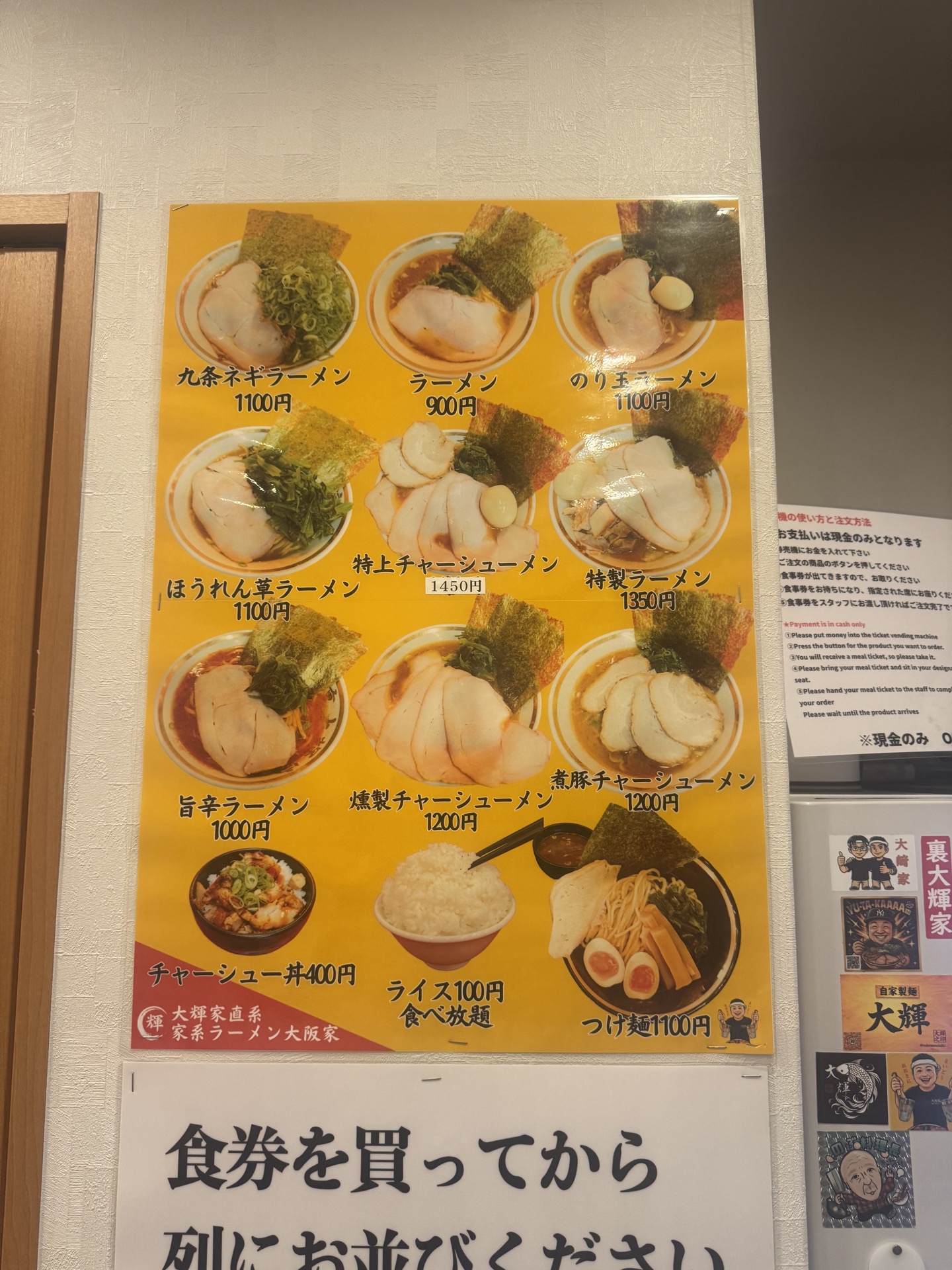
| Item | Price | Alex's Take |
|---|---|---|
| ラーメン (Ramen) — Standard | ¥900 | The entry point. Salty, fatty, umami-forward. Pair with rice or it'll overwhelm by the end. Start here if it's your first visit. |
| のり玉ラーメン (Nori Tama) — Seaweed & Egg | ¥1,100 | What I order. The soft-boiled egg cuts through the fat in a way that makes the second half of the bowl easier than the first. The nori goes broth-soaked and that's correct, not a flaw. |
| 旨辛ラーメン (Umakara) — Spicy Ramen | ¥1,000 | The one that gets people. Heat stacked on top of an already assertive broth. Skip this on your first visit unless spice is genuinely your baseline, not just something you can handle. |
| 燻製チャーシューメン (Kunsei Chashu) — Smoked Chashu | ¥1,200 | The smoke note comes through clearly — not atmospheric, actually present in the meat. Worth the upgrade if pork is the reason you're here. |
| 特上チャーシューメン (Tokujo Chashu) — Premium Chashu | ¥1,450 | More chashu than one bowl probably needs. Order it if you're skipping the rice add-on, which would be a mistake — but at least you'd understand the decision. |
| チャーシュー丼 (Chashu Don) — Chashu Rice Bowl | ¥400 | Redundant when the ¥100 rice bar is right there. The only argument for it is if you want toppings on your rice, which I don't think you need here. |
| ライス食べ放題 (Rice All-You-Can-Eat) | ¥100 | The actual play. One coin. Unlimited refills. The mechanic the whole visit is built around — see the full breakdown below. |
One thing nobody mentions: the free cucumber kimchi-style pickled vegetables sitting on the counter alongside the rice bar. Crunchy, sharp, and they cut the fat better than anything else at the table. I ate more of them than I'm prepared to admit in print.
Counter Seats, 4-Minute Bowls, and How to Time Your Visit
Getting here is straightforward. Kintetsu Nippombashi Station Exit 6 — three minutes on foot, flat, no navigation required. Osaka Metro Sakaisuji Line, same station, give yourself five. Either way you're cutting through the edge of Dotonbori's commercial corridor, and the red OSAKAYA sign is visible once you're on the right block.
Timing matters more than transit. The lunch window (11:00–15:00) fills fast but turns over fast — counter-only seating means nobody lingers, and bowls hit the counter in roughly four minutes after you sit. The dinner window (17:00–23:00) is busier, especially post-8pm when Dotonbori's tourist crowd spills into the side streets. Aim for 11:30am or 17:30 — just ahead of the full rush.
The tip that isn't in any guidebook: those backless stools feel fine for twenty minutes and considerably less fine for thirty-five. Eat with purpose. This is not a lingering situation. The kitchen was notably clean on my visit — the kind of clean where someone had wiped the underside of the counter lip, which you notice precisely because most places at this price point don't bother.
The ¥100 Rice Mechanic: Here's Exactly How It Works
Here's the mechanic, plainly stated, because the title promised it and you deserve a direct answer.
You pay ¥100 at the ticket vending machine when you order your ramen — it's a separate button on the machine, labeled ライス食べ放題. That single ¥100 payment buys you unlimited rice refills for the duration of your meal. Not one bowl. Unlimited. You get up, walk to the rice bar on the left wall, fill a white bowl from the commercial rice cooker yourself, and return to your stool. Repeat as many times as you want. The only rule — posted clearly and enforced — is 「お残し厳禁」: don't leave food uneaten. Take what you'll finish.
Why this matters: iekei broth is specifically engineered to be eaten with rice. The saltiness, the fat layer, the intensity — it's not a bug. It's designed so you pour broth over plain white rice midway through your bowl and suddenly you have a second, completely different eating experience happening in the same sitting. The kitchen even posts it: 「当店のラーメンはライスが合います」— "Our ramen pairs well with rice." That's the chef telling you the correct way to eat here.
The math: ¥900 standard ramen + ¥100 rice = ¥1,000 for a meal that will keep a grown adult full for four or five hours. Go for the ¥1,100 nori tama version with the rice and you're at ¥1,200, eating better than you would at three times the price two blocks deeper into Dotonbori.
Honest verdict: OSAKAYA is a textbook iekei value play if you come hungry, fat-tolerant, and committed to the rice add-on. Expect your bowl in four minutes and leave satisfied for under ¥1,200. But if you dislike heavy broths, need reservations, or want somewhere you can sit for an hour — this will frustrate you. The irregular closing days are a real inconvenience. The cash-only ticket machine feels baffling for exactly thirty seconds before it clicks. The staff were friendly in the way that busy people are friendly — efficient, direct, no performance. I liked it. I went back.
My rating: 4/5 — The ¥100 unlimited rice mechanic alone justifies the detour. The irregular hours and the uncompromising fat level are the only things keeping it from a higher score.
Frequently Asked Questions
Is OSAKAYA ramen near Nippombashi Station worth the wait?
Yes, with caveats. It's three minutes from Kintetsu Nippombashi Station Exit 6, and the queue — when there is one — moves fast because counter seating turns over quickly. Worst-case wait is ten to fifteen minutes at peak lunch. Arrive at 11:30am or just after 17:00 and you'll likely walk straight in. The bigger caveat isn't the queue anyway — it's that the broth is heavy and the stools are not built for anyone planning a long sit.
How does the ¥100 rice all-you-can-eat work at OSAKAYA Osaka?
You select the ライス食べ放題 button on the ticket vending machine when you order — it costs ¥100 and covers unlimited rice refills for your entire meal. The rice bar is self-service on the left wall: commercial rice cooker, stacked white bowls, free cucumber kimchi-style pickled vegetables alongside. The rule is strict — no leaving food uneaten, posted and enforced. Pour broth over your rice toward the end of the bowl. That's not a tip, that's just how iekei works.
Is OSAKAYA ramen too spicy or too rich for beginners?
Spice is controllable — the standard menu isn't inherently hot, and you can request reduced seasoning at the counter: 「辛さ控えめでお願いします」. Skip the 旨辛ラーメン (Umakara, ¥1,000) if heat isn't your thing. Richness is a different problem entirely. The broth is fatty and salty in a way that some people find deeply satisfying and others find genuinely exhausting before they've finished the bowl. I've watched both reactions happen at the same counter. If tonkotsu generally gives you trouble, this one won't be the exception.
What's the difference between standard and special ramen at OSAKAYA?
The standard ラーメン (¥900) is the base bowl — tonkotsu-soy broth, thick straight noodles, basic toppings. The のり玉ラーメン (¥1,100) adds soft-boiled egg and extra nori, which is what I order and probably what most people should order. The 特上チャーシューメン (¥1,450) is maximum chashu, which is a lot of pork even by Osaka standards. Most solo visitors hit the sweet spot at ¥1,100 nori tama plus the ¥100 rice — that's ¥1,200 out the door and nothing in the bowl you'll regret.
Can you make reservations at OSAKAYA or is it walk-in only?
Walk-in only. No reservations — the counter format and fast turnover make the system self-regulating. Arrive at 11:30am for lunch or 17:15 for dinner to minimize waiting. The bigger risk isn't the queue — it's the irregular closing days (不定休). There's no published schedule, so check their social media the morning of your visit. Showing up to a shuttered shopfront after planning your afternoon around it is avoidable and annoying in equal measure.
Worth Bookmarking for Tomorrow
I put together a half-day eating loop through Namba and Dotonbori that doesn't double back on itself — OSAKAYA fits into the lunch slot cleanly, and the rest of the route avoids the obvious tourist drag. It's here if you want it.
📍 Location & Access
📍 View on Google MapsMore Osaka Food Guides
🎫 Book Osaka Activities on Klook
Skip the queues. Book in advance and save.
Post a Comment