
The bowl is smaller than you think it's going to be. I'm putting that first because every other review buries it, and you deserve to know before you've already committed to the queue. The cutlet is thin. The rice doesn't overflow. If your lunch baseline is a standard Namba izakaya set, your first reaction will be mild alarm — and then, about thirty seconds later, you'll understand why the guy next to you is already scraping the bottom of his bowl with an expression of focused, slightly aggressive satisfaction. I've been in Osaka four years, eaten katsudon in places ranging from train station counters to places that list their pork provenance in calligraphy. Yoshibei is not the biggest bowl I've had in this city. It's the one I've thought about most on the train home.
📋 At a Glance
| 📍 Address | 14-2 Namba Sen-nichi-mae, Chuo-ku, Osaka (道具屋筋商店街) |
| 🕐 Hours | 11:00 AM – 9:30 PM daily (last dine-in order 9:00 PM); open 7 days incl. holidays |
| 💴 Budget | ¥600–¥1,380 per person; most people spend ¥880–¥1,100 |
| 🚇 Access | Nankai Namba Station, south exit — 3 min walk into Doguya-suji arcade |
| 💳 Payment | Ticket machine (has English); cash + PayPay, Suica/ICOCA, Visa/MC/Amex/JCB, Alipay, WeChat Pay |
| ⭐ Best For | Solo budget traveler who wants fast, authentic pork cutlet over rice without the tourist tax |

Why This Shoulder Pork Recipe Still Beats 'Fancier' Cuts (The Price vs. Portion Honesty Check)

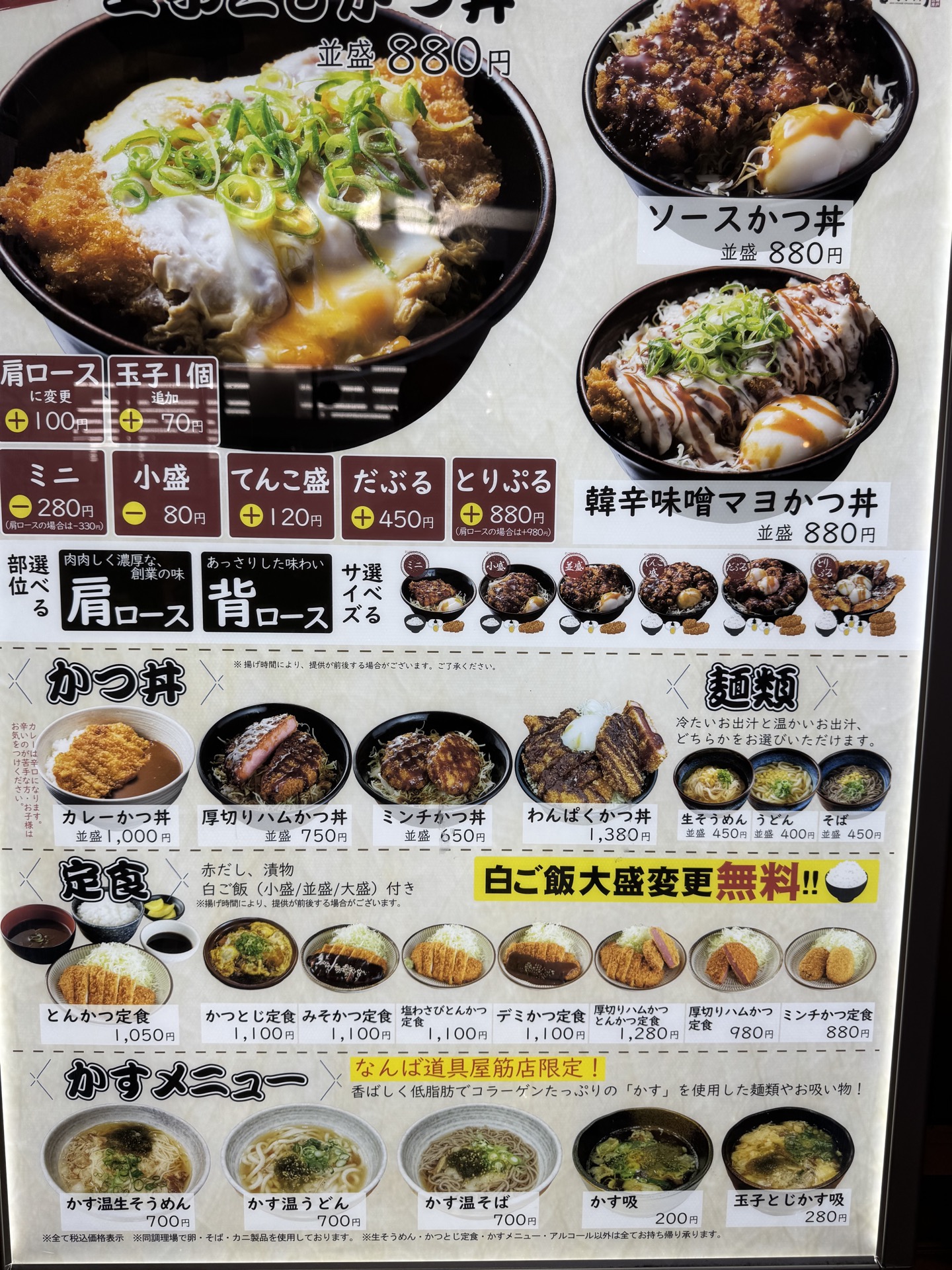
The ticket machine is just inside the entrance. It has an English interface — press the flag icon, top right corner, it's small and easy to miss if you're panicking about the person behind you. Here's what the machine doesn't make obvious: the shoulder loin upgrade (肩ロース, +¥100) and the heap size upgrade (てんこ盛, +¥120) are separate buttons on the same first screen, listed below the main bowl options. They don't appear on a second page. If you select your bowl and go straight to payment, you've skipped both. Don't do that. Scroll down before you pay.
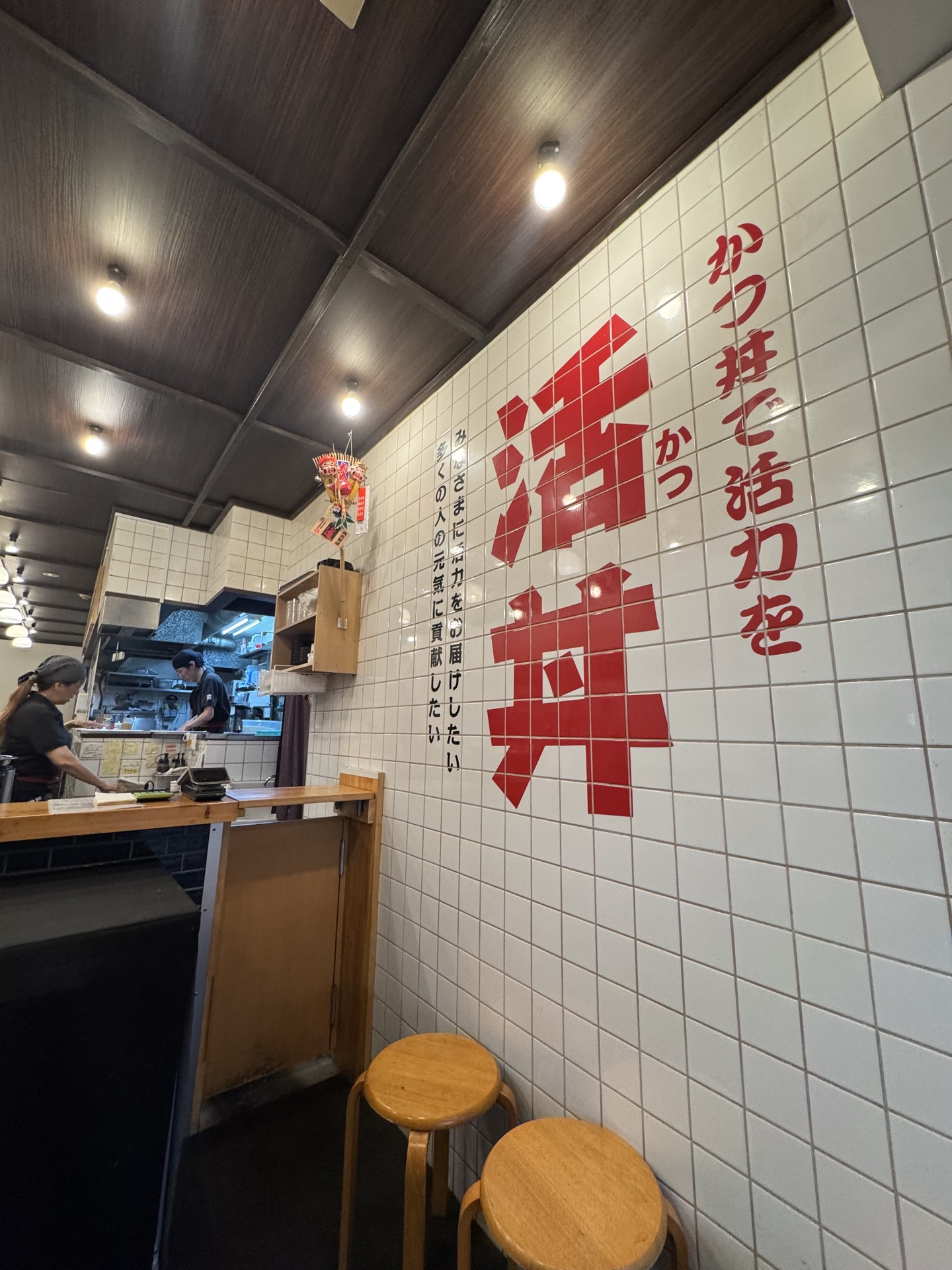
I found a stool at the pine counter and that's when the smell hit me properly: hot oil and sweet-savory dashi and something faintly smoky I couldn't identify, all of it concentrated under a low ceiling. The kitchen is open — white square tiles, two guys working without talking, one on the fryer and one on assembly, moving like people who have divided this labor so many thousand times the division has become unconscious. I ordered the 韓辛味噌マヨかつ丼 — the Korean spicy miso mayo katsudon — with the shoulder loin upgrade. I handed over my ticket. The bowl was in front of me before I'd finished unwrapping my chopsticks. Not quickly. Mechanically. Like the kitchen had already known I was coming.
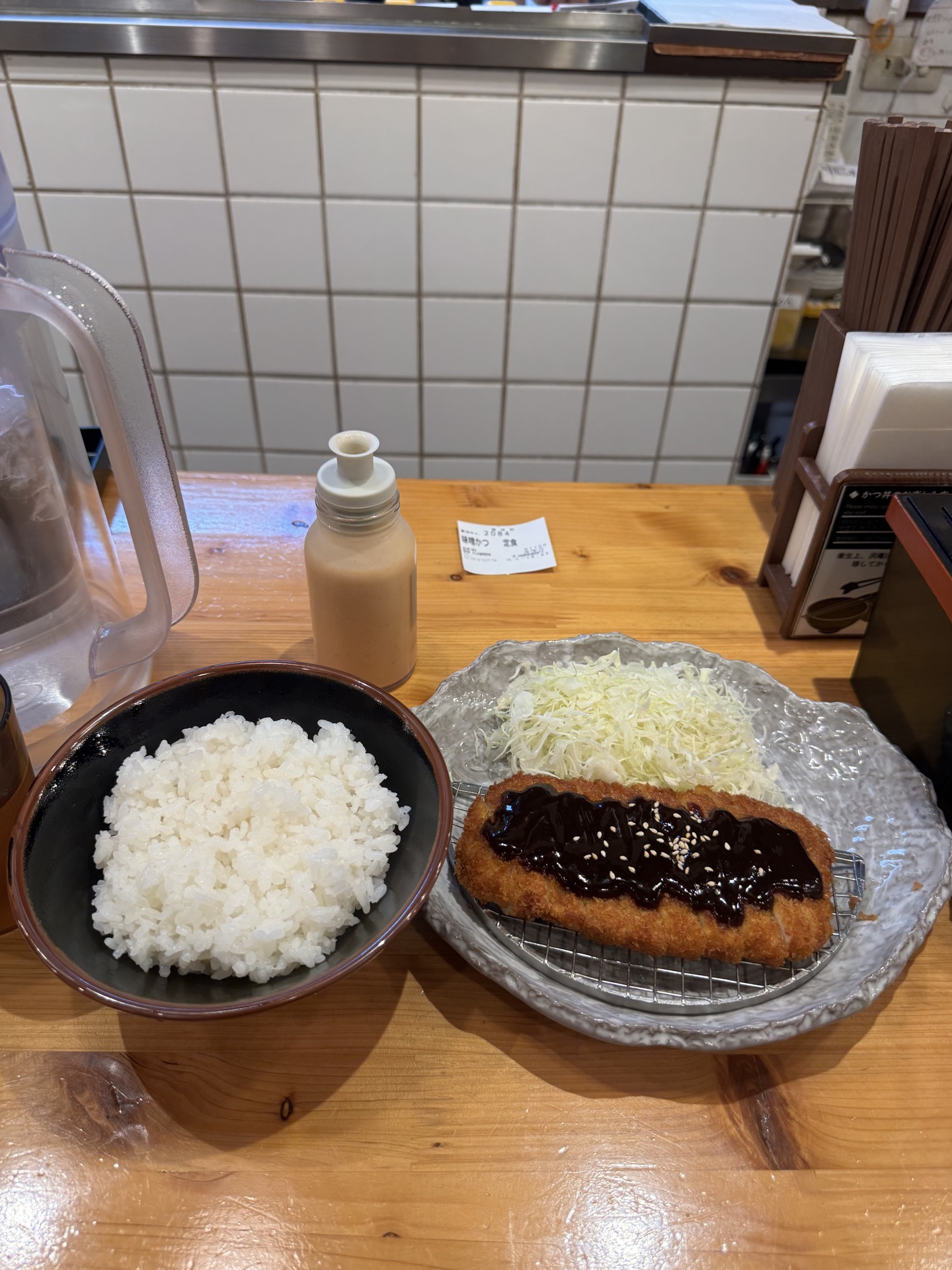
Smaller than I expected — and I'd read the Tabelog reviewers who wrote "器が小さめなのでボリュームもそれなり," bowl is small, portion is modest, they weren't being dramatic — but what arrived in that small bowl proceeded to make the portion argument irrelevant, one bite at a time. The shoulder pork — 肩ロース, chuck-shoulder, not the leaner back loin most katsudon spots use — has fat marbled through it in a way that changes how the whole bowl reads. The cutlet came sliced into four strips, each about a centimeter thick, the panko coating a solid two millimeters of crunch that held its texture even after sitting in broth long enough for me to arrange myself on the backless stool and properly register where I was. That last part shouldn't be possible. Katsudon broth is hot and the egg is wet and panko loses the fight almost immediately in lesser bowls. Here it didn't, not fully, not for the first several bites. The outside stayed brittle while the pork inside had already absorbed enough dashi to taste like it belonged there. The coating wasn't just fried correctly — it was thick enough to act as insulation.
Japanese reviewers call the overall flavor "濃厚で肉肉しい味" — rich, unmistakably meaty. That phrase is accurate in a way food writing phrases rarely are. The shoulder cut earns it. The ¥100 upgrade isn't optional. It's the whole point of coming here.
One honest caveat: even with the shoulder loin, the rice-to-cutlet ratio left me wanting one more strip of pork. I'd skipped the +¥120 てんこ盛 heap upgrade. Sitting there with an empty bowl and eleven minutes left on my lunch hour, I ran the numbers on whether I could justify a second ticket. I didn't go back up. I've been quietly irritated about that decision ever since — not dramatically, just in the low-grade way you're irritated when you know exactly what you should have done and did the other thing anyway. Add it. You already know you want to.
The Dashi Broth: What I Could Actually Taste and What I Couldn't Figure Out
The restaurant describes their broth as 門外不出のだし — a house dashi they don't share the recipe for. I'm not going to pretend that's a revelation I uncovered. It's on their own signage. What I can tell you is what it tasted like from the bottom of an actual bowl.
Less sweet than you expect. Most katsudon broth is mirin-heavy enough that by halfway through you're eating something that's drifted toward dessert. This one doesn't go there. The sweetness exists — you need it to bind the egg — but it cuts off early, and what's left is a clean umami base that tastes more of kombu or bonito than of sugar. I scraped the bottom of the bowl and wasn't fatigued. That sounds like a low bar. In katsudon it isn't.
There was also something faintly smoky underneath everything, more pronounced in the last third of the bowl than the first. I couldn't place it. Not bonito — I know what that smells like. Not the pork fat, which disperses differently. It was in the liquid itself, subtle enough that the guy next to me, who ate his entire bowl in the time it took me to identify the smell, might not have registered it at all. I didn't ask the staff. I probably should have. But the counter moves fast and there were seven people behind me in line and asking a prep cook to explain his broth mid-service in my mediocre Japanese felt like the wrong move. So: I don't know what it is. I'm telling you it's there.
The Full Menu Breakdown
| Item (JP / EN) | Price | Alex's Take |
|---|---|---|
| 玉子とじかつ丼 / Egg-topped Katsudon (regular) | ¥880 | The baseline. Clean broth, runny egg. Start here if it's your first visit. |
| ソースかつ丼 / Sauce Katsudon (regular) | ¥880 | Uses Kobe Nagata local sauce. Tangier, bolder. A legitimate second option. |
| 韓辛味噌マヨかつ丼 / Korean Spicy Miso Mayo Katsudon | ¥880 | The one most visitors miss. Order with shoulder loin. Full breakdown below. |
| カレーかつ丼 / Curry Katsudon | ¥1,000 | Rich, slightly thick curry sauce. Good, but it kills the panko crunch faster than anything else on this menu. |
| ミンチかつ丼 / Minced Pork Katsudon | ¥650 | Budget floor. Decent texture, less complex flavor. Fine for a light lunch. |
| わんぱくかつ丼 / "Naughty" Big Katsudon | ¥1,380 | For when you're actually hungry. Addresses every portion complaint in one order. |
| 肩ロース upgrade / Shoulder Loin | +¥100 | Same screen as your bowl selection. Scroll down before paying. Not optional. |
| てんこ盛 / Heaping size | +¥120 | Also on the first screen. Fixes the portion issue before it becomes one. I skipped it. Still annoyed. |
| うどん / Udon (hot or cold) | ¥400 | Solid pairing if you're hungry. Don't overthink it. |
| みそかつ定食 / Miso Katsu Set | ¥1,100 | Comes with red miso soup and pickles. Makes the most sense for dinner. |

Korean Spicy Miso Mayo Variant: The One Most English Guides Skip Entirely
Almost nobody writing in English mentions the 韓辛味噌マヨかつ丼 and I find that baffling. The heat level sits somewhere between "you'll notice it immediately" and "you'll need water" — it has a gochujang sharpness that arrives in the first bite and builds slowly rather than spiking, which means by the middle of the bowl you're working slightly harder than you expected to, in a way that is entirely welcome. The mayo base rounds it. The miso underneath both of them adds a depth that the standard egg-topped version, good as it is, simply doesn't have. Japanese regulars describe it as "癖になる逸品" — the thing you find yourself reconstructing in your head on the train home. I was doing exactly that on the Midosuji Line, replaying the sauce ratio, trying to figure out whether the smokiness I'd noticed in the broth was amplified by the gochujang or separate from it entirely.
One technique that actually matters here: let the egg yolk break naturally into the sauce before your first bite rather than stirring it in. The yolk tempers the gochujang sharpness and rounds the miso without flattening either of them. If you mix it aggressively, the sauce goes homogeneous and you lose the layering that makes the variant worth ordering in the first place. Drag, don't stir. The shoulder loin upgrade is especially important on this bowl — the intramuscular fat in the chuck cut holds its presence against the heavy sauce in a way the leaner back loin doesn't. The back loin gets a little lost under all that gochujang. The shoulder pushes back.
The standard 玉子とじかつ丼 with shoulder loin is less dramatic — the broth does more of the work, the heat isn't a factor. Good. Just not the reason to come back a second time. If you can't handle moderate spice, you know what to order. If you can, the Korean variant is the one.
To get here: Midosuji Line or Nankai Main Line to Nankai Namba Station, south exit, straight into Doguya-suji shopping arcade. Three minutes in on your left. White backlit sign. Almost certainly a queue.
Best window: 11:00 AM sharp on weekdays. The non-obvious thing about this arcade: it's covered, so when it rains in Osaka, foot traffic doesn't disappear — it moves indoors. Except Doguya-suji pulls fewer rain-shelter wanderers than Shinsaibashi does, because most people aren't in the market for commercial kitchen equipment on a rainy Tuesday. Rainy weekday mornings are consistently shorter waits. I've confirmed this more times than is strictly healthy.
Walk-In Strategy: How to Order in 90 Seconds Without Missing the Upgrade
Walk-in only. No reservations. Fourteen counter seats on backless wooden stools, nothing else. Enter, buy ticket from the machine, hand it to staff, sit, eat, leave. Ten minutes if you're decisive. The machine has English — flag icon, top right, small and easy to miss. Select your bowl. Then scroll down on the same screen before hitting pay. The shoulder loin (+¥100) and heap size (+¥120) buttons are there. Both of them. One screen. Don't leave without pressing at least the first one.
My 90-second order for first-timers: 韓辛味噌マヨかつ丼 + 肩ロース + てんこ盛. Korean spicy miso mayo, shoulder loin, heap size. Total: ¥1,100. You've fixed the portion issue before it becomes one, you've ordered the cut that defines what this place does, and you've got the variant that'll actually stay with you. If spice isn't your thing: 玉子とじかつ丼 + 肩ロース + small udon. Clean, classic, done.
Go if: you want fast, cheap katsudon with a broth that doesn't wear out its welcome, and ten minutes at a counter suits you fine. Skip if: you need generous plating for the price, or you want to sit somewhere for an hour. This place was built for people who have somewhere to be and want to eat well anyway. On a Tuesday at noon in Namba, that was me exactly.
My rating: 4/5 — The shoulder pork and the broth still earn it. The portion still won't.
Frequently Asked Questions

Does Katsudon Yoshibei Namba accept reservations or is it walk-in only?
Walk-in only, first-come-first-served. Fourteen counter seats, no phone reservation system. UberEats and mobile takeout are available if you want to eat elsewhere. For eating in, 11:00 AM on weekdays is your cleanest window.
How much does katsudon cost at Yoshibei and what's the best value order?
Standard egg-topped katsudon is ¥880. Most people land between ¥880 and ¥1,100 once they add the shoulder loin upgrade (+¥100) and heap size (+¥120). The minced pork version is ¥650 if you're watching every yen. For pure value-per-flavor, the Korean spicy miso mayo with shoulder loin at ¥980 is the strongest case on the menu.
What makes Yoshibei's katsudon different from other Osaka katsudon restaurants?
Two things. They use 肩ロース — shoulder-chuck pork — a cut with more intramuscular fat than the back loin most places default to. The panko coating is noticeably thick, around two millimeters, which gives it enough structure to stay crispy longer than it has any right to in a broth-soaked bowl. And the house broth is deliberately non-sweet, which prevents the flavor fatigue
📍 Location & Access
📍 View on Google MapsMore Osaka Food Guides
🎫 Book Osaka Activities on Klook
Skip the queues. Book in advance and save.
Post a Comment